
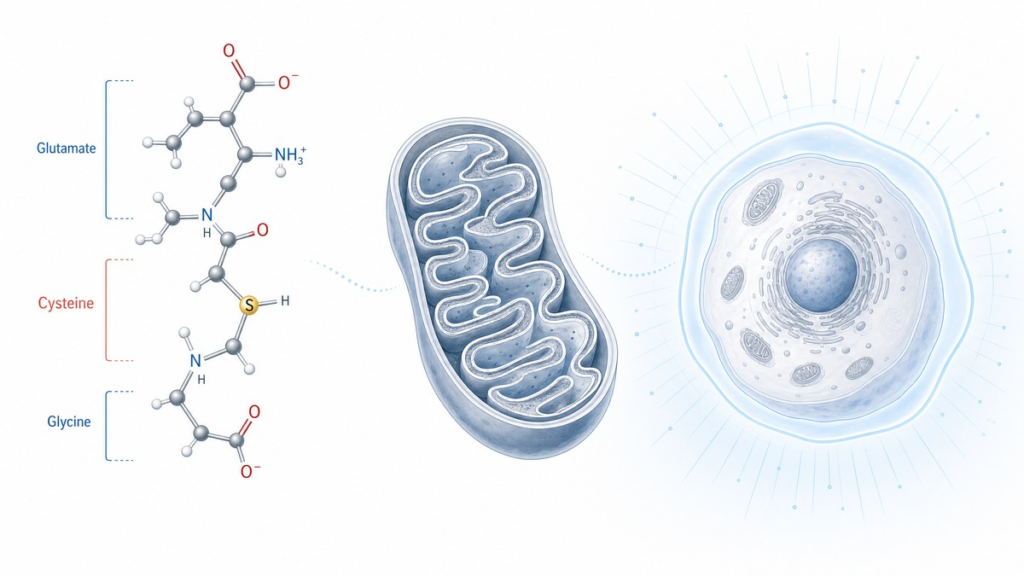
Glutathione (GSH) is often referred to as the body’s “master antioxidant,” and for good reason. Found in nearly every cell in the human body at concentrations similar to glucose or cholesterol, this simple tripeptide—composed of cysteine, glycine, and glutamic acid—is the primary defense mechanism against cellular degradation, oxidative stress, and premature aging .
While glutathione is powerful on its own, its true potential in longevity and metabolic optimization is unlocked when combined with advanced peptide therapies. This article explores the cellular mechanisms of glutathione and how it acts as a critical foundational layer when stacked with Ipamorelin, MOTS-c, NAD+, and Retatrutide.
The Cellular Mechanics of Glutathione
To understand why glutathione is essential, we must look at the cellular level. Cells constantly produce energy within the mitochondria. This process, while necessary for life, generates reactive oxygen species (ROS)—highly unstable molecules that can damage DNA, proteins, and cell membranes. This damage is known as oxidative stress.
Glutathione exists in two states within the cell: reduced (GSH) and oxidized (GSSG). In a healthy cell, the ratio of GSH to GSSG is greater than 100:1. When a cell is under oxidative stress, this ratio drops significantly .
The primary functions of glutathione include:
- Direct Free Radical Scavenging: GSH directly neutralizes superoxide anions, hydroxyl radicals, and carbon radicals before they can damage cellular structures .
2. Mitochondrial Protection: Glutathione is actively pumped into the mitochondria, where it protects mitochondrial DNA (mtDNA) from the oxidative exhaust of energy production. The preservation of mtDNA is directly correlated with longevity .
3. Detoxification: Through the enzyme glutathione S-transferase, GSH binds to toxins, heavy metals, and persistent organic pollutants (POPs), making them water-soluble so they can be excreted by the body .
4. Immune Modulation: Glutathione regulates the proliferation of lymphocytes and enhances the cytotoxicity of T-cells and natural killer (NK) cells, forming the backbone of a robust immune response .
The Synergy of Stacking: Glutathione and Advanced Peptides
While optimizing endogenous glutathione production is crucial, exogenous supplementation provides a massive protective buffer when pushing the body’s metabolic and regenerative capacities with peptide therapies.
1. Glutathione + Ipamorelin: The Anti-Aging and Recovery Stack
Ipamorelin is a selective Growth Hormone Secretagogue (GHS) that stimulates the pituitary gland to release natural pulses of Human Growth Hormone (HGH). Elevated HGH levels accelerate tissue repair, increase lean muscle mass, and promote lipolysis (fat burning).
The Synergy: The rapid cellular turnover and increased metabolic rate induced by Ipamorelin naturally generate higher levels of oxidative stress. If the body lacks sufficient antioxidant capacity, this stress can blunt the regenerative benefits of HGH. Glutathione acts as the cellular shield in this equation. By neutralizing the ROS generated during rapid tissue repair, glutathione ensures that the new cells produced under the influence of Ipamorelin are healthy, functional, and protected from immediate oxidative damage. This combination is the gold standard for anti-aging and accelerated recovery.
2. Glutathione + MOTS-c + NAD+: The Ultimate Mitochondrial Matrix
MOTS-c (Mitochondrial Open Reading Frame of the 12S rRNA-c) is a mitochondrial-derived peptide that regulates metabolic homeostasis. It translocates to the nucleus under stress to activate AMPK, promoting mitochondrial biogenesis and enhancing cellular energy capacity. NAD+ (Nicotinamide Adenine Dinucleotide) is a critical coenzyme that fuels the sirtuin longevity pathways and facilitates the transfer of electrons in the mitochondria.
The Synergy: This trio forms a complete mitochondrial optimization protocol. MOTS-c signals the cell to build more mitochondria and burn fat for fuel. NAD+ provides the necessary enzymatic fuel for these new mitochondria to function efficiently. However, increased mitochondrial activity inevitably means increased oxidative exhaust.
Research shows that MOTS-c actually upregulates the NRF2 pathway, which is responsible for the endogenous production of antioxidants, including glutathione . By supplementing with exogenous glutathione alongside MOTS-c and NAD+, you provide the exact protective molecules the cell needs to handle the massive increase in energy output. This prevents “reductive stress” and ensures that the enhanced mitochondrial function translates to pure, clean energy rather than cellular damage .
3. Glutathione + Retatrutide: Protecting the Liver During Rapid Fat Loss
Retatrutide is a groundbreaking triple-hormone-receptor agonist (GLP-1, GIP, and Glucagon) that produces unprecedented weight loss — up to 24.2% in 48 weeks . The glucagon component of Retatrutide directly stimulates lipolysis in the liver, rapidly clearing hepatic fat and increasing resting energy expenditure.
The Synergy: Rapid, massive fat loss places a significant burden on the liver. As adipose tissue breaks down, stored toxins and lipid peroxides are released into the bloodstream and processed by the liver. This can cause a temporary spike in hepatic oxidative stress and inflammation.
Glutathione is the liver’s primary detoxification molecule. Stacking glutathione with a powerful metabolic agent like Retatrutide provides the liver with the necessary resources to safely process and eliminate the massive influx of mobilized fatty acids and released toxins. This ensures that the rapid weight loss achieved with Retatrutide is metabolically clean and does not result in secondary hepatic stress.
Conclusion
Glutathione is not just a standalone supplement; it is the biological prerequisite for advanced cellular optimization. Whether you are accelerating recovery with Ipamorelin, maximizing mitochondrial output with MOTS-c and NAD+, or undergoing profound metabolic transformation with Retatrutide, glutathione provides the essential antioxidant shield that allows these peptides to work at their absolute peak potential without causing collateral cellular damage.
References
[1] Pizzorno, J. (2014). Glutathione!. Integrative Medicine: A Clinician’s Journal, 13(1), 8–12.